
NEWS
Under a moonless winter sky, Russian commanders believed darkness would be their greatest ,They were wrong. Late at night, a large Russian force launched a surprise assault against fortified Ukrainian positions in eastern Ukraine, counting on low visibility to overwhelm defenses. Instead, they ran into a battlefield ruled by technology and preparation. Ukrainian units, equipped with superior night-vision systems, thermal optics, and coordinated drone surveillance, detected the movement almost immediately 👁️📡. As the attack unfolded, formations broke apart, vehicles were disabled, and momentum collapsed within hours. By dawn, the scale of the losses revealed a staggering imbalance — not of manpower, but of situational awareness. The encounter exposed a widening gap in night-fighting capability and showed that darkness no longer guarantees concealment. Modern warfare doesn’t sleep. And on this battlefield, the side that sees first decides everything. 👇 Here’s why this night attack became a disaster.

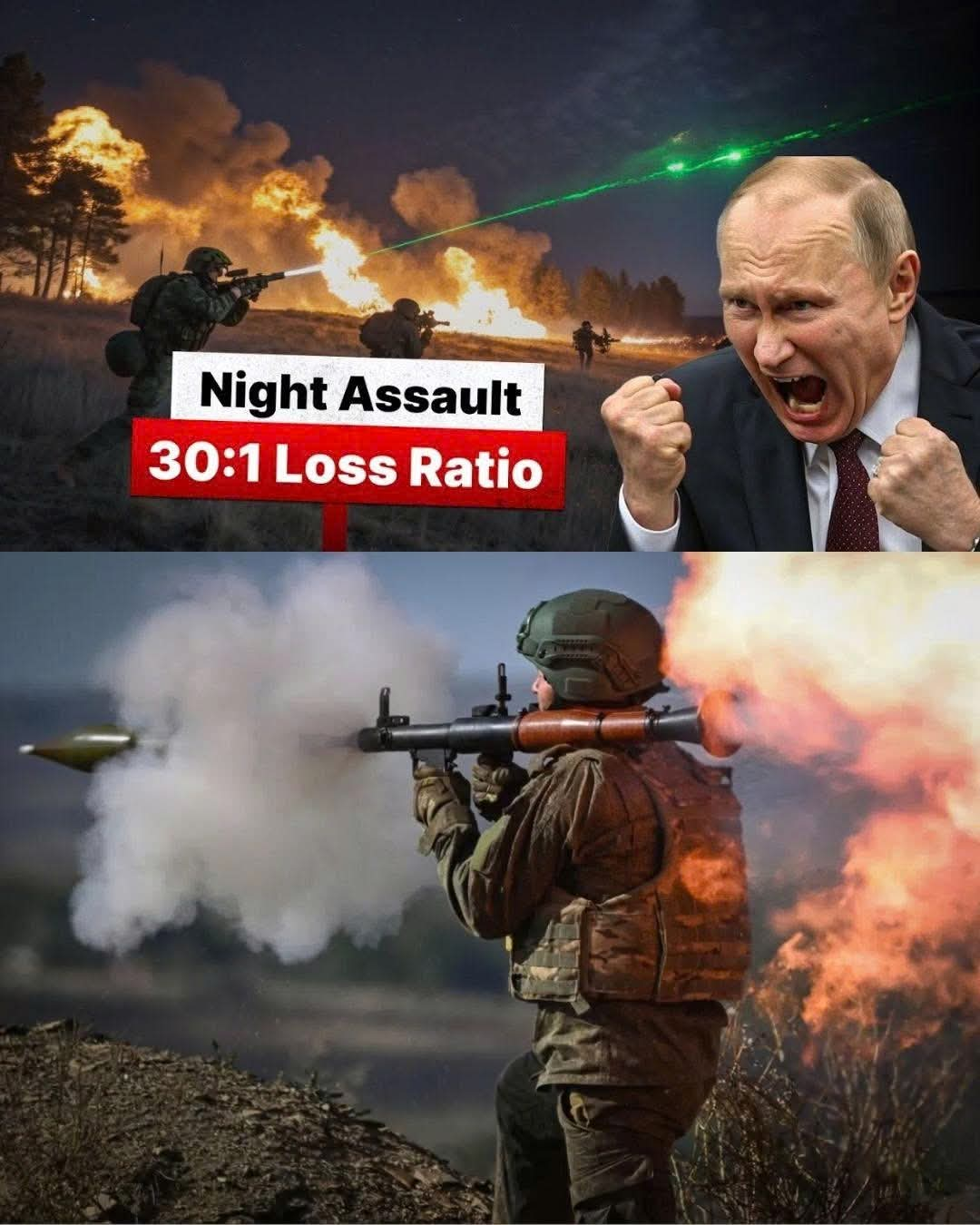
Under a moonless winter sky, Russian commanders believed darkness would be their greatest ,They were wrong.
Late at night, a large Russian force launched a surprise assault against fortified Ukrainian positions in eastern Ukraine, counting on low visibility to overwhelm defenses. Instead, they ran into a battlefield ruled by technology and preparation.
Ukrainian units, equipped with superior night-vision systems, thermal optics, and coordinated drone surveillance, detected the movement almost immediately 👁️📡. As the attack unfolded, formations broke apart, vehicles were disabled, and momentum collapsed within hours. By dawn, the scale of the losses revealed a staggering imbalance — not of manpower, but of situational awareness. The encounter exposed a widening gap in night-fighting capability and showed that darkness no longer guarantees concealment.
Modern warfare doesn’t sleep.
And on this battlefield, the side that sees first decides everything.
👇 Here’s why this night attack became a disaster.
Late at night, as freezing winds swept across eastern Ukraine, a large Russian assault force began moving toward fortified Ukrainian positions. The plan was simple—and familiar: exploit low visibility, strike fast, overwhelm defenses before the enemy could react. In past wars, darkness offered concealment. It slowed detection, blurred coordination, and favored massed attacks.
But this battlefield was no longer governed by old rules.
Darkness Meets Modern Warfare
Almost as soon as Russian units advanced, the illusion of invisibility shattered. Ukrainian forces, prepared for precisely this scenario, were not relying on the naked eye. Instead, they controlled the night through technology.
Advanced night-vision systems, thermal imaging optics, and a tightly coordinated network of reconnaissance drones were already scanning the area. Heat signatures appeared clearly against the cold ground. Vehicle engines glowed. Infantry formations stood out in stark contrast. What Russian commanders believed was a hidden approach was, in reality, a clearly mapped movement corridor 👁️📡.
Within minutes, Ukrainian units had identified the size, direction, and composition of the assault.
The Collapse Begins
As the attack unfolded, Russian formations began to fracture. Vehicles moved into exposed zones already marked by Ukrainian observers. Precision strikes followed—targeting key assets, supply vehicles, and command elements. Drones hovered overhead, adjusting fire in real time, turning the battlefield into a constantly updated digital map.
Momentum vanished. Units that expected confusion instead encountered coordinated resistance. Communication breakdowns followed. Without reliable situational awareness, movements slowed, then stalled. What was meant to be a swift nighttime breakthrough became a chaotic struggle to regroup.
By the early hours of morning, the outcome was no longer in doubt.
A Battle Decided Before Dawn
When daylight finally revealed the battlefield, the
BREAKING…Avalanche Linked to Rangers’ Artemi Panarin After Contract Talks Update….

“You Won’t Believe What Terrifies Connor McDavid” The Oilers superstar finally reveals his bizarre phobia — click to find out what haunts him off the ice
⚠️ “HE SAID WHAT NO POPE WAS SUPPOSED TO SAY” — Fury Erupts Worldwide After Pope Leo XIV Utters the Unthinkable on a Topic the Vatican Has Tiptoed Around for Centuries, Leaving Cardinals Pale, Faithful Divided, and Rome Buzzing With Talk of a Line That Can Never Be Uncrossed 😱⛪ In a sharp, ominous narrator’s tone, the lead hints at stunned silence inside the chamber, aides exchanging panicked glances, and a single sentence that detonated like a spiritual bomb, forcing believers and critics alike to ask whether this Pope just shattered a sacred boundary or exposed a truth long buried 👇

BREAKING: Trump Now Facing 7 Articles of Impeachment — Could This Spell Legal Trouble He Can’t Dodge? Read the explosive details below ⤵️
BREAKING …Panic on stage! Travis Kelce rushes to save Taylor Swift after a sudden medical emergency — the superstar music icon collapsed as Travis desperately called an ambulance, leaving fans in tears and the entire venue in shock. Travis Kelce tearfully recounts Taylor Swift’s frightening condition when….see more

TRAGIC LOSS OR DEADLY CONSEQUENCE? ICE Operation in Minneapolis Ends With Mother of Three Shot — What Really Happened? Read now
BREAKING: U.S. FREES Russian Crew After Moscow’s Oreshnik Hypersonic WARNING — Power Politics Just Went NUCLEAR Russia Allegedly Strikes Deep in Ukraine After BELLA-1 Crew Detained — U.S. Backs Down Full breakdown insideWhat this mean for global security?full breakdown inside??

PARDON BLOCKED: GOP Drops Legal Hammer — T.r.u.m.p’s Last Escape Route Suddenly SLAMMED SHUT 👉 What this means for his future — Full breakdown below 👇

Under a moonless winter sky, Russian commanders believed darkness would be their greatest ,They were wrong. Late at night, a large Russian force launched a surprise assault against fortified Ukrainian positions in eastern Ukraine, counting on low visibility to overwhelm defenses. Instead, they ran into a battlefield ruled by technology and preparation. Ukrainian units, equipped with superior night-vision systems, thermal optics, and coordinated drone surveillance, detected the movement almost immediately 👁️📡. As the attack unfolded, formations broke apart, vehicles were disabled, and momentum collapsed within hours. By dawn, the scale of the losses revealed a staggering imbalance — not of manpower, but of situational awareness. The encounter exposed a widening gap in night-fighting capability and showed that darkness no longer guarantees concealment. Modern warfare doesn’t sleep. And on this battlefield, the side that sees first decides everything. 👇 Here’s why this night attack became a disaster.

ENOUGH IS ENOUGH: BRING OUR MONEY HOME. Stop endless wars. Invest in health care, roads, and homes. Stand with me. NO MORE NATION-BUILDING ABROAD WHILE AMERICA CRUMBLES. End reckless wars. Rebuild America. Demand better or else…see more shocking details 👇

UNBELIEVABLE SCENE 🚨 Taylor Swift BREAKS DOWN IN TEARS as She Describes the Horrifying Moment ICE Allegedly Drew Guns on a Doctor Who Was Trying to Save a Woman’s Life — “I’ve Never Seen Anything Like This”VISIBLY SHAKEN While Recounting How ICE Allegedly Aimed Weapons at a Doctor…see more 👇
